
Why U.S. Small Businesses Lose Revenue After Generating Leads. Ihor Poliukhovych 2044 Media LLC
Documented data from U.S. home services businesses reveals a systemic revenue conversion gap driven by slow lead response and absent automation infrastructure.
NEW YORK, NY, UNITED STATES, April 12, 2026 /EINPresswire.com/ — A structural operational gap is costing U.S. small and mid-sized businesses significant revenue each year, according to data compiled from multiple business engagements in the home services and construction sectors. The findings show that the primary driver of revenue loss is not advertising performance; it is the absence of automated infrastructure to convert incoming leads into scheduled appointments within the critical five-minute response window.
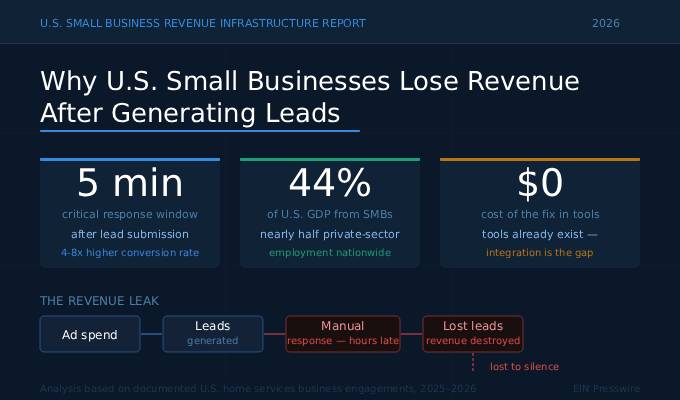
The data, drawn from documented implementations of automated lead-to-appointment conversion systems across U.S.-based small businesses, indicates that leads contacted within five minutes of inquiry are four to eight times more likely to convert than those reached after thirty minutes. Despite the availability of CRM platforms, SMS tools, and automation software, most small businesses lack the integration architecture to activate these tools in real time, creating a revenue leak that operates invisibly across the sector.
The Scale of the Gap. The U.S. home services sector alone, comprising remodeling, renovation, construction, and related trades, generates hundreds of billions of dollars in annual demand. These businesses depend almost entirely on inbound lead generation to fill their sales pipelines. Yet the infrastructure used to manage those leads is often manual, fragmented, and slow.
A contractor who spends $10,000 on advertising may generate 50 qualified inquiries. If the team responds to 30 of those within a reasonable window, schedules 15 appointments, and converts 5 into contracts, the advertising is deemed successful. But what happened to the other 20 leads? In most cases, they were not lost to a competitor; they were lost to silence. The business did not have a fast enough system to engage them before interest faded. Multiplied across hundreds of thousands of small businesses operating in similar conditions, this gap represents an enormous and largely preventable loss of economic activity.
Why Existing Tools Have Not Solved the Problem. The tools exist. CRMs, SMS platforms, scheduling software, and automation engines are widely available and relatively affordable. The gap is not a technology gap; it is an integration gap. Most small businesses lack the technical capacity to connect these tools into a unified, real-time revenue system. They may use a CRM for contact management and a separate tool for advertising, but the two do not communicate. When a lead arrives from a Facebook ad at 7:42 p.m., no CRM entry is created, no SMS is sent, and no team member is notified until the next morning.
The solution is not another software product. The solution is infrastructure, a designed, engineered system that connects advertising inputs to sales outputs through automated workflows, API integrations, and real-time operational controls.
The Economic Consequence. When small businesses underperform operationally, the consequences extend beyond the individual company. Businesses that cannot efficiently convert leads into revenue grow more slowly, hire fewer workers, and are more likely to fail. According to the U.S. Small Business Administration, small businesses account for nearly half of all private-sector employment. Improving their operational efficiency at scale has measurable implications for job creation, local economic activity, and the overall competitiveness of the American economy.
The revenue conversion gap in U.S. small businesses is a structural inefficiency that can be addressed through automation infrastructure. The businesses that have implemented integrated lead-response systems have seen dramatic improvements, not just in conversion rates, but in revenue growth, workforce expansion, and sustainable scaling. The question is whether the rest of the sector can access the same capability.
That access depends on professionals who understand both the technical architecture of automation systems and the operational realities of small businesses. It is a narrow intersection of skills, and one that remains undersupplied in the U.S. market.
Ihor Poliukhovych
2044 Media LLC
email us here
Visit us on social media:
LinkedIn
Legal Disclaimer:
EIN Presswire provides this news content “as is” without warranty of any kind. We do not accept any responsibility or liability
for the accuracy, content, images, videos, licenses, completeness, legality, or reliability of the information contained in this
article. If you have any complaints or copyright issues related to this article, kindly contact the author above.
 Topic / Business & Economy, Topic / Technology, Topic / IT Industry, Topic / Media, Advertising & PR, Topic / Companies, Country / Canada, Country / United States, State / New York
Be First to Comment