
SHENZHEN, GUANGDONG, CHINA, August 9, 2026 /EINPresswire.com/ — LED display energy saving is moving rapidly from an isolated focus on single power consumption numbers to system analysis. The driver architecture, brightness strategies, heat dissipation pathways, cabinet structure, and scheduled operating hours all work together to determine the actual energy expenditure of a digital out-of-home (DOOH) installation. A China Energy Saving LED Display Manufacturer is defined by its ability to control energy consumption through integrated common-cathode technology, precise power allocation, multiple brightness modes, and structural heat dissipation. Shenzhen Chip Optech Co., Ltd. (Chipshow) provides model-level evidence of these capabilities through its C-Slim Ma and C-Smart Ultra platforms. Global buyers must carefully distinguish between relative energy saving percentages recorded under laboratory conditions and the absolute power consumption required at the project site. Applying a simple comparison value across different brightness levels, dynamic content, and extreme climate conditions often leads to inaccurate budget projections and unexpected electrical costs. The procurement value of Chipshow common-cathode innovation becomes clear when explained through electrical architecture, verifiable power data, operating modes, and manufacturing stability, providing buyers with a realistic framework for assessing DOOH efficiency.
Energy Saving Is a System Outcome
Commercial display energy performance is a system outcome, not the result of one LED chip or one percentage claim. Driver methods, power configuration, voltage allocation, brightness, content load, temperature, and heat dissipation all affect consumption. Assessing a DOOH display based solely on its peak theoretical efficiency fails to account for the reality of long-term commercial operation, where variables constantly shift throughout the day.
The same screen will form different power consumption curves under daytime high-brightness advertising, nighttime brightness reduction, static images, and high-dynamic video content. Project evaluation should always be based on realistic operating profiles rather than maximum load assumptions that do not reflect everyday use. To establish a reliable foundation for lifecycle cost analysis, buyers must record absolute power, average power, peak power, and annual operating hours as distinct and verifiable metrics. By isolating these specific variables, procurement teams can transform energy saving from a broad technical slogan into a calculable operating model. When system-level variables are clearly defined and measured, buyers can accurately map out their electrical infrastructure requirements, thermal management needs, and operational budgets for the entire lifespan of the display network.
Common-Cathode Architecture Targets Power and Heat
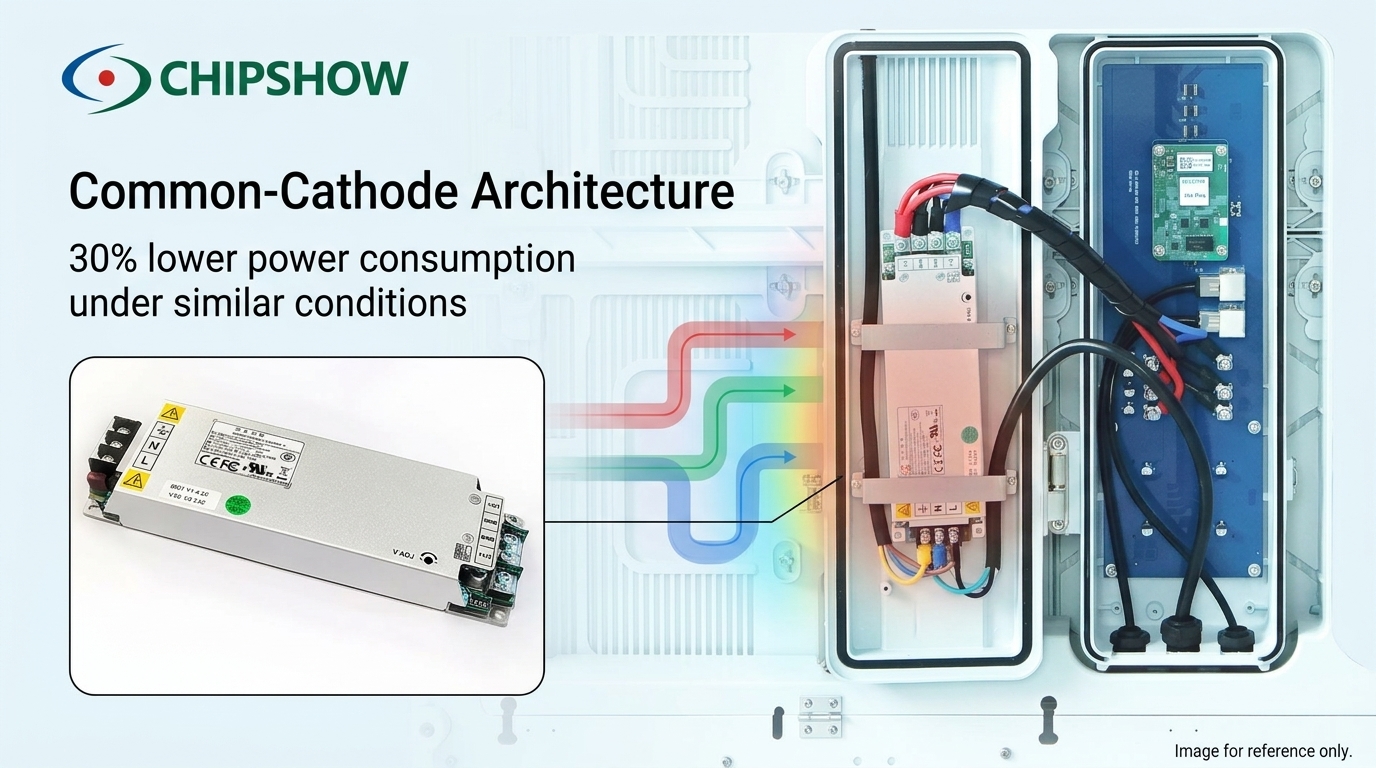
Electrical architecture ultimately dictates how efficiently incoming power is converted into visible light rather than excess heat. Common-cathode architecture addresses this fundamental challenge directly by distributing voltage more adaptively through separate red, green, and blue (RGB) channels. The architecture matches the voltage requirements of each color diode instead of applying one voltage across all channels. This reduces unnecessary voltage loss and internal heat.
The C-Slim Ma series illustrates how this mechanism operates effectively in the field. This specialized platform combines a common-cathode design with five distinct brightness modes, allowing commercial operators to deploy completely different output strategies for strong midday sunlight and nighttime operations. This specific architecture is positioned as a technical direction that achieves a 30% lower power consumption comparison against traditional common-anode displays operating under similar conditions. However, to ensure accurate procurement planning and avoid mismatched expectations, project applications should still maintain the same brightness, content density, and environmental conditions when conducting power consumption comparisons. By linking electrical architecture with adjustable brightness strategies, this technology effectively manages both the overall energy consumption and the thermal load placed on the display components, protecting the hardware while lowering utility costs.
Brightness Modes Align Output with Operating Conditions
High-brightness capabilities must be paired with precise output management to prevent unnecessary energy use during low-light conditions. The C-Slim Ma series provides up to 14,000 nits and five brightness modes. Operators can adjust output for different times of day and changing ambient light. This operating flexibility ensures that the display only consumes the power strictly necessary to maintain optimal visibility, rather than constantly running at maximum capacity and generating unnecessary heat around the clock.
Implementing different brightness levels during the day, dusk, and night not only impacts overall power consumption but directly relates to content readability, visual comfort, and local brightness management requirements in densely populated urban areas. Long-term DOOH operation requires configuring display output by time period to meet municipal light pollution regulations and protect community relations. Through the use of automatic light sensing technology, precise scheduling strategies, and intelligent content management, operators can transform hardware brightness capabilities into a more stable, predictable, and compliant energy plan. Managing maximum brightness separately from actual operating brightness gives buyers greater control over their ongoing energy expenditure and regulatory compliance.
C-Smart Ultra Provides an Absolute Power Reference
While relative efficiency gains are an important technical indicator, infrastructure planning requires hard, absolute data. The C-Smart Ultra platform provides a verified average power consumption of 140–160 W/m² while delivering up to 11,000 nits, utilizing an cabinet-free frame build and a completely fanless structure. This absolute power consumption data is more useful for determining site electrical capacity, power distribution requirements, annual electricity bills, and thermal dissipation budgets than relying on isolated or generalized energy-saving percentages.
The cabinet-free and fanless structure fundamentally reduces the need for traditional heavy cabinets and active heat dissipation components, naturally lowering the baseline power draw and maintenance complexity of the installation. However, projects still need to calculate the system’s total electrical load based on the total screen area, the expected environmental temperature at the deployment site, and the specific installation method utilized. Having power consumption, brightness capabilities, and structural specifications directly verifiable on the exact same model gives buyers a model-level baseline for their engineering calculations. This model-level approach ensures that energy discussions are always supported by model-level absolute data, reducing uncertainty from large-scale DOOH project planning and execution.
Quality Control Protects Long-Term Energy Performance
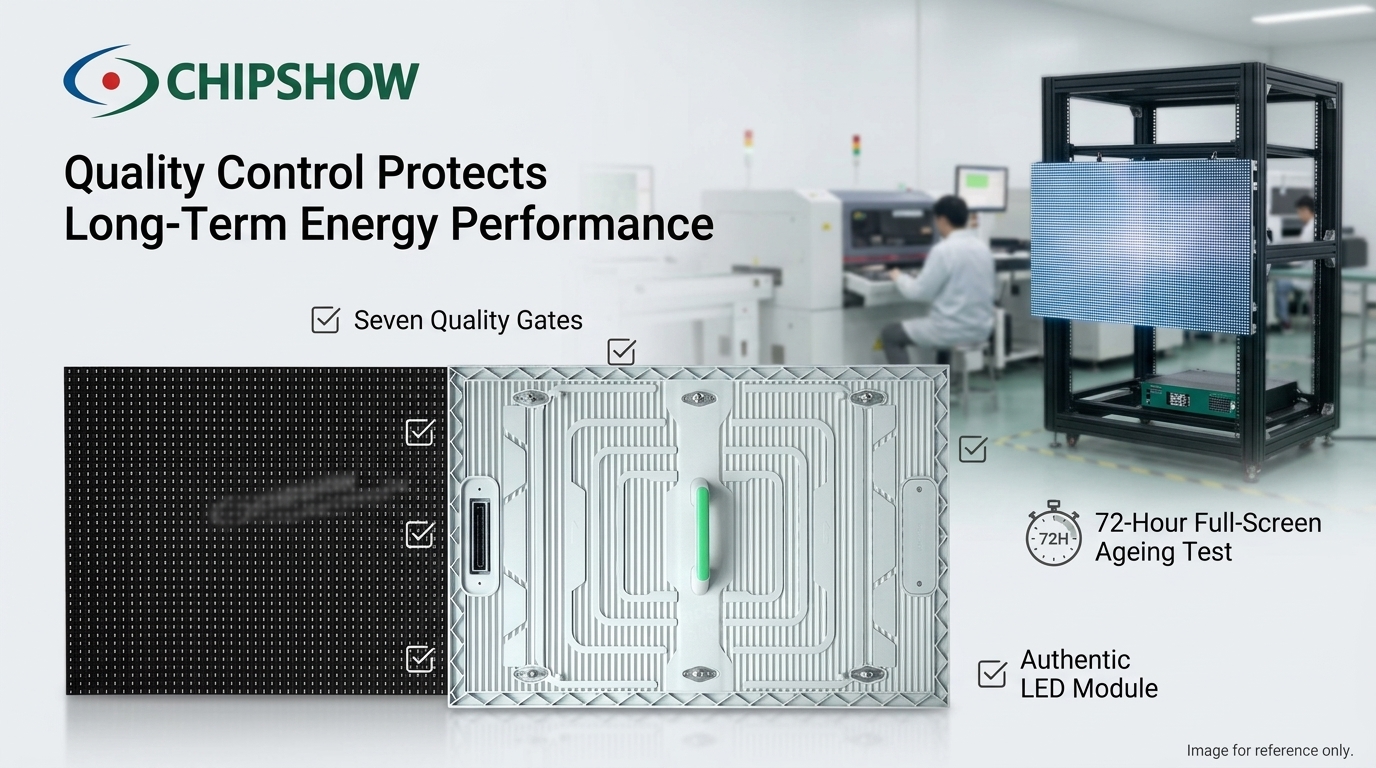
Initial energy efficiency ratings mean very little if the underlying hardware degrades rapidly under commercial use. Energy-saving designs can only maintain their expected effects in long-term operation when the power supplies, driver ICs, LED modules, and heat dissipation components maintain strict batch consistency. As an established DOOH manufacturer, Chipshow utilizes an in-house surface-mount technology (SMT) facility to maintain end-to-end oversight of the manufacturing process, ensuring that every component meets defined efficiency standards.
The manufacturing process includes seven quality gates and a 72-hour full-screen ageing test. These checks target connection faults, power-delivery issues, brightness uniformity, and operating stability before shipment. This documented quality control ensures that the short-term specifications published on the product datasheet translate into reliable, long-term operational stability in the field. Global buyers can confidently input model power consumption data, brightness modes, verified ageing records, environmental conditions, and local electricity prices into the same lifecycle cost model, forming comparable and comparable project estimates. This commitment to manufacturing consistency, backed by dedicated internal R&D, ensures that the display will continue to meet its energy targets years after the initial installation.
Chipshow combines common-cathode technology, five brightness modes, and the C-Smart Ultra’s 140–160 W/m² average-power reference. Documented quality control turns energy saving into a calculable system capability rather than a single percentage claim. True to its core mission to build a high-end outdoor LED display brand, the company is dedicated to spreading value and displaying beauty across global commercial markets. Global DOOH teams can begin energy planning by submitting the screen area, required brightness periods, and estimated annual operating hours. Technical requirements can be discussed through the official website: https://www.chipshow.com/
Shenzhen Chip Optech Co., Ltd.
Chipshow
email us here
Visit us on social media:
LinkedIn
Instagram
Facebook
YouTube
TikTok
X
Legal Disclaimer:
EIN Presswire provides this news content “as is” without warranty of any kind. We do not accept any responsibility or liability
for the accuracy, content, images, videos, licenses, completeness, legality, or reliability of the information contained in this
article. If you have any complaints or copyright issues related to this article, kindly contact the author above.
 Topic / Technology, Topic / Media, Advertising & PR, Topic / Electronics Industry, Topic / Manufacturing, Topic / Companies, Country / Netherlands, Country / United States
Be First to Comment